
How to Tell If a Threatening Reply Is Noise or Coordinated Harassment
 Nicholas Van Landschoot
Not every hostile reply deserves the same attention. These are the signals that show when separate-looking posts start behaving like one coordinated effort against a principal.

The first challenge when it comes to social media monitoring for protective intelligence is collection. It is essential to collect every single data point around the principal that could potentially contain a threat. The next challenge is determining which data points constitute threats. This article deals with the third challenge, determining what threats are actually worth paying attention to. There are many reasons to pay attention to one threat more than another, from specificity to severity, and this article will focus on identifying coordinated campaigns.
Why should a protective intelligence team care about these campaigns in the first place? Organization usually means fixation, and fixation is what turns online hostility into something that can affect the principal offline. Uncoordinated anger mostly stays online. Coordinated campaigns are more likely to move into doxxing, sustained reputational attacks, and in the worst cases language or planning that points toward real-world harm. The job is not to treat every nasty reply as equal. It is to notice when separate-looking posts start behaving like one effort.
Account Fingerprint
Brand-new templated accounts are easy to set up cheaply at scale. It is a lot harder to spin up an army of bots made up of accounts with a 10-year history. Age alone is not enough. Post volume, bio language on platforms that support it, profile image reuse, and other thin-profile tells usually travel together. A single angry reply from a long-lived personal account is usually noise. When several thin, recently created accounts show up around the same principal saying similar things, the cluster matters more than any one reply.
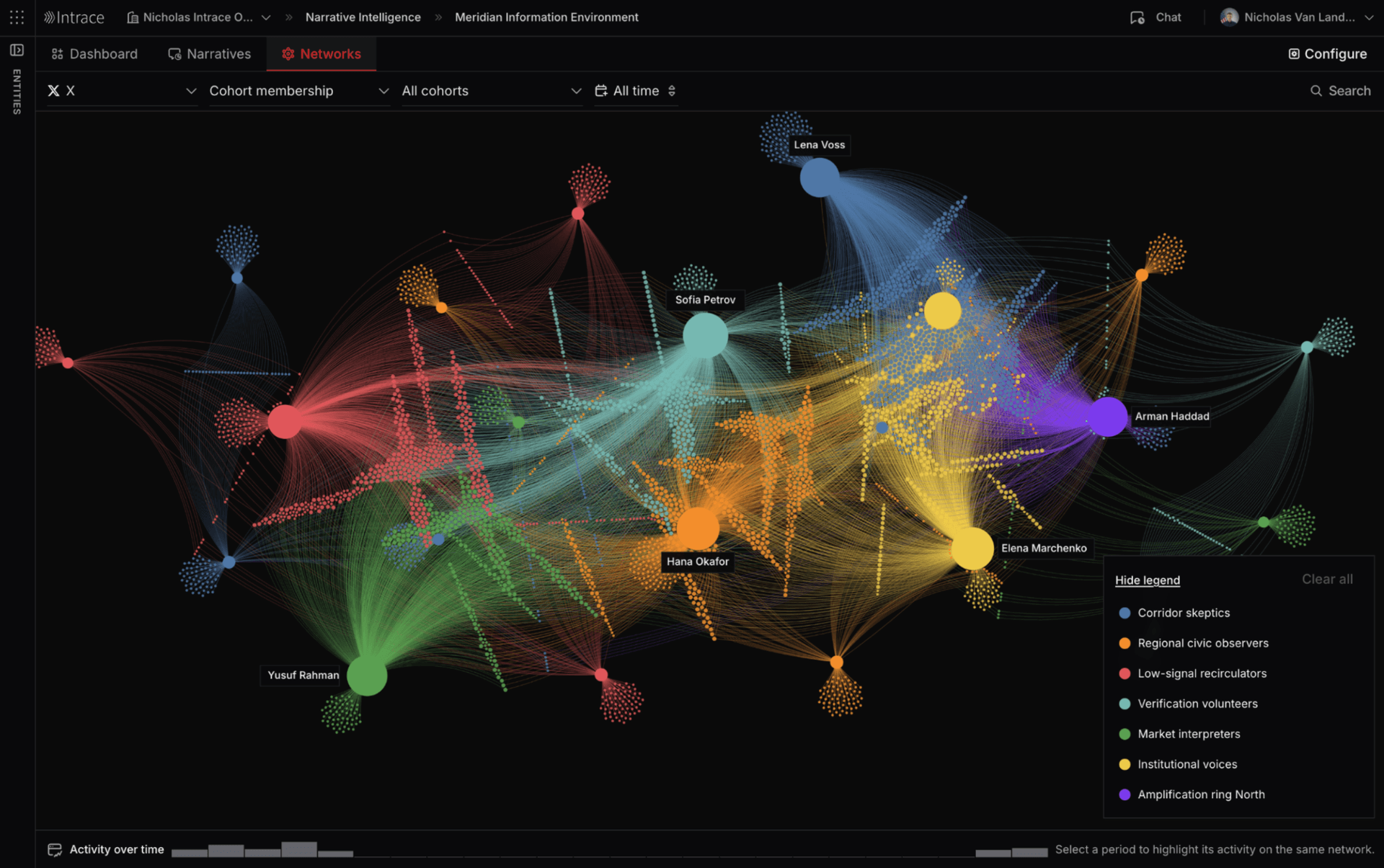
Intrace packages these factors into a bot score allowing analysts to visualize which accounts exhibit the most bot-like behavior and how they interact with each other.
Network Overlap
Natural accounts talk to a messy mix of people. Coordinated ones often talk to each other. If an account posts with almost no engagement, or only ever gets engagement from the same handful of accounts, it is probably not a normal personal profile. The sharper tell is when several of those accounts also share overlapping followers or following lists and then show up against more than one principal. A shared audience against one target can still be organic anger from a real community. A shared audience repeated across multiple principals is harder to explain away.
That distinction matters because some overlap is expected. Accounts that mostly follow patient-advocacy and insurance-reform pages are likely to be hostile toward a health insurer CEO after a viral denial-of-care story. That is not surprising. If that same cluster suddenly starts pushing a tightly aligned narrative about a mid-size regional grocery chain's warehouse staffing software, the audience and the topic no longer fit. That mismatch is worth more attention than raw follower overlap by itself.
Timing
Natural discussion takes time to play out. People see a post, react, quote it, and the conversation spreads from a few visible centers. Coordinated activity often skips that shape. Many small posts appear around the same time without a clear originating post that earned the attention. Major events on the ground are the main exception. If a chemical plant fire forces an evacuation in a midwestern suburb, simultaneous posts are normal. If that same burst shows up around a controversial remark a CFO made at a niche private-equity ops dinner that almost nobody attended, the timing needs a better explanation than organic reach.
Copy-Paste Signal
This used to be simple. Campaigns reused the same wording or a few algorithmic variants, so identical phrases were enough. Cheap generative tools have made exact matching less reliable. What still holds is structure. Watch for different wording that still keeps the same claims in the same order, returns to the same rare proper nouns, or repeats the same accusation frame across accounts that otherwise look unrelated. Natural anger overlaps thematically and still wanders. Scripted anger can be paraphrased and still feel assembled from one outline.
Cross-Target Pattern
One angry person tends to pick one fight. Coordinated harassment reuses accounts, phrases, and media across principals, brands, or employees in the same orbit. The useful question is whether the same handles keep appearing wherever this person or organization shows up, including a board member, a spouse's public account, or a related company page. Volume against one CEO can still be a bad news cycle. Reuse across related targets is a stronger sign that the activity is organized. The same pattern shows up when executive contact packs get mirrored across dump sites and then the same accounts start hitting several company leaders within hours.
Escalation Path
Most online hostility stays at insults, sarcasm, or political disagreement, and protective intelligence can usually leave that alone. What changes the priority is movement. A reply that only says someone is hated is common. A reply that adds personal details, then travel or schedule information, then language that implies approach or real-world harm belongs in a different category even when the tone stays calm. Digital teams can keep watching when the content is hostile but non-specific. Once location, family, travel, or approach language appears, physical security and the broader EP team need to be in the loop. Coordination makes that path more dangerous because the same narrative can be amplified until someone less restrained acts on it.
Platform Hop
A lot of doxxing and harassment work spends a day or two in closed channels before it ever hits a public reply thread. By the time the pile-on is visible on X, the organizing may already have happened elsewhere. That is why a hop into Telegram, Discord, forums, or fresh alt accounts matters. Shared channels, forwarded target packs, and follow-on tasking tend to show up there first. Ban evasion alone does not prove a campaign. When the same persona comes back quickly with the same narrative and the conversation leaves moderated spaces, collection should widen instead of stopping at the original post.
None of these signals is meant to turn every hostile comment into an incident. Together they answer a simpler question. Is this one person having a bad day, or is the organization forming around the principal? Thin new accounts, recycled networks, odd timing, shared structure, and repeated handles across targets are usually enough to justify watching the cluster. Escalation language or a move into closed channels is usually enough to raise it beyond the social feed.