
OSINT Search Techniques for Investigations and Threat Monitoring
 Nicholas Van Landschoot
Build better OSINT searches for investigations and threat monitoring. Learn when to search broadly, use Boolean queries, collect context, and filter with AI.
Your search strategy decides what gets found and what gets missed. That matters whether you are investigating a person of interest, researching a company, or monitoring threats against an executive or brand.
The risk starts before you review a single result. Add the wrong restriction to a query, and relevant content never reaches your investigation. No later filter can recover it from data you did not collect.
An effective OSINT search strategy combines subject research, broad discovery, platform search rules, and review of the results. It also reaches beyond direct keyword matches to the accounts, conversations, and related topics that give a post meaning.
This guide focuses on searching and monitoring at scale. The goal is to collect relevant public information across large volumes of data while keeping collection costs and review work under control.
OSINT search strategy goes beyond Google dorking
Google dorking uses advanced search operators to narrow results, such as restricting a search to a website or an exact phrase. It is useful, but it covers only part of the problem.
Jason Hill's Google Dorking for OSINT: The Practical Investigator's Guide is a useful reference for that part of your work.
A broader search strategy also answers questions about coverage. Which names and related topics should you include? Which sources can you search? What happens to replies and attached media? How will you detect gaps as the subject changes?
A precise query is valuable only if it still returns the information you need.
1. Set the goal before choosing keywords
Start by defining what you need to find and what a missed result would mean.
For due diligence, you might need to establish a company's ownership, disputes, and public history. For executive protection, you need to find relevant discussion about a person, including content that never uses an obvious threat word. Those goals call for different sources, terms, and review rules.
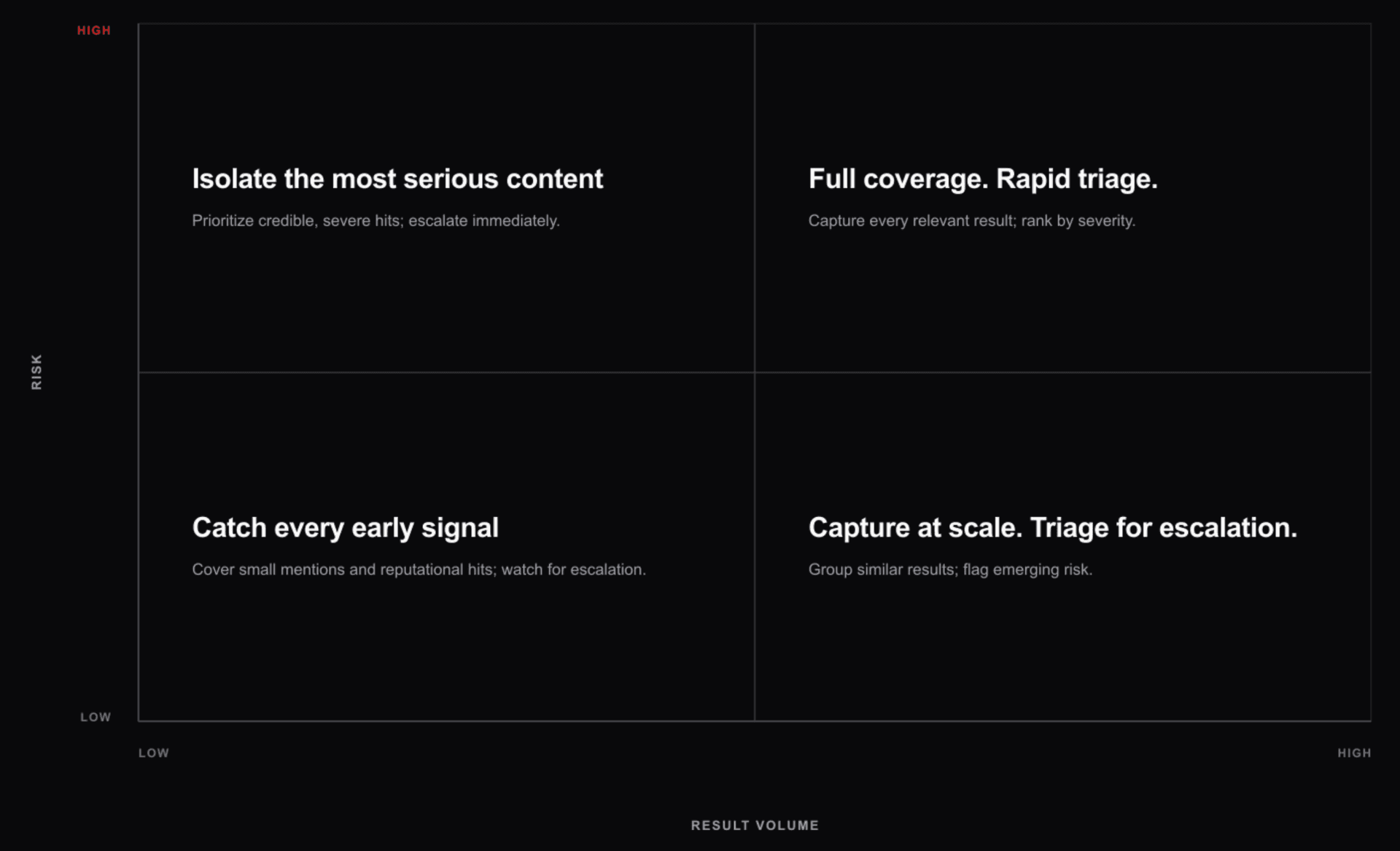
Then measure the volume. “High volume” should describe a real collection limit, such as a result cap, cost, or delay. It should not simply mean more posts than one analyst wants to read.
A distinctive executive name can support broad collection. A global brand or a company named after a common word can produce far more unrelated content. Even a usually quiet name can generate a surge during a major event.
Use a short collection sample to test your assumptions before making the query more restrictive.
For low-volume terms, search broadly. Searching the core term without modifiers will usually give better coverage and reduce the chance of missing relevant content. For truly high-volume terms, adding one or a few specific qualifiers can help reduce collection volume while keeping the search useful.
| Search situation | Starting approach | Main risk to check |
|---|---|---|
| Distinctive name with manageable volume | Search the name and important variants broadly | Missing indirect references or aliases |
| Common name shared by several people | Use several searches with different identity clues | Requiring a detail that relevant posts omit |
| Brand name with unrelated meanings | Test narrow exclusions or separate contextual queries | Removing posts that discuss both meanings |
| Broad topic such as terrorism | Define the relevant places, events, sources, or subtopics | Collecting more than your access and budget support |
Keep searches broad where collection is manageable. Narrow them when measured volume or ambiguity justifies the loss of coverage.
2. Research the subject beyond their name
Before writing queries, learn how people refer to the subject.
For a company, collect its brands, products, executives, facilities, projects, and relevant local issues. For a person, consider public aliases, titles, account handles, and known associations relevant to the investigation. Include other languages and transliterations where the subject's activity warrants them.
Imagine a fictional company called Alder Ridge Holdings that is building a warehouse known locally as the Eastbank project. Residents might discuss “Eastbank,” “the new warehouse,” or the planning dispute without naming the company.
Monitoring only “Alder Ridge Holdings” would miss those discussions regardless of how well you filter the results.
Build a small record of each search term, what it refers to, and why it belongs in the investigation. This makes the configuration easier to review and update when another analyst takes over.
3. Test query expansion instead of assuming it works
Some search systems return related forms or interpret a query beyond its exact words. Others depend much more closely on the terms you provide.
Do not assume an unquoted search will find every misspelling, nickname, abbreviation, or translation. Search behavior also differs between a platform's website, its API, and a third party tool using its data.
Test the interface you actually collect through. Use known public examples to see whether your query finds the variants that matter.
A practical approach combines explicit searches for important names and aliases with broader discovery queries. You do not need to invent every possible typo. Add variants when subject research or observed results give you a reason to include them.
Expect overlap. Prefer removing duplicate records by stable post identifiers where available. Excluding a term from a broad query can create a gap if the narrower query fails, reaches its collection limit, or covers a different period.
4. Build queries for each platform and access method
The same query will not behave the same way everywhere.
X's advanced search interface provides options for words, exact phrases, exclusions, accounts, and dates. Its API query documentation separately describes query construction and restrictions that depend on access level. A query that works in the browser should still be tested in your collection tool.
For each source, confirm what you can search and retrieve. Check whether results include replies, how far back they go, whether you must request more pages, and whether ranking or result caps limit what you receive.
If a source offers weak keyword search but useful access to specific public accounts, account monitoring can be the better starting point. Where neither is available, search engine discovery or another permitted data source can help, with its coverage limits recorded.
Query design and source access are separate parts of the same problem. A well written query cannot overcome a source that does not expose the relevant content.
5. Use Boolean search to resolve ambiguity
Boolean search combines alternatives, required terms, and exclusions. It is most useful when a broad term has several meanings or produces more content than you can collect.
The logic is simple, but the syntax varies by platform:
| Search logic | Purpose | What to watch for |
|---|---|---|
| OR | Include names, aliases, or other alternatives | A broad alternative can dominate the results |
| AND | Require another relevant concept | Relevant posts may omit that concept |
| Exact phrase | Match a particular sequence of words | Variations in wording can be missed |
| Exclusion | Remove a known source of unrelated results | Relevant posts can contain the excluded term too |
Suppose your subject shares a name with a sports team. Excluding the team's full name can be less restrictive than requiring every result to mention the subject's employer.
But inspect what the exclusion removes. A threat could compare the subject with the team or appear in a conversation that mentions both.
When several meanings compete, separate contextual queries often give you more control than one query with a long list of required words.
6. Do not make threat keywords the only route into collection
A query that requires both an executive's name and a word such as “kill” will find only a narrow set of statements.
It misses content that uses an alias, relies on a parent post for context, or expresses intent with language you did not predict. It also misses relevant behavior that deserves review without containing an explicit threat.
Where volume permits, collect discussion of the subject first and assess its meaning afterward. Direct threat queries can supplement that collection, but they should not define its entire scope.
There is still a role for specific language. Terms observed in a relevant community, local dialect, or recurring discussion can reveal material that a formal name does not. Build these terms from research and actual results.
Search for language people use. Do not rely only on the words an analyst would use to describe their behavior.
7. Collect replies, media, and surrounding context
Some relevant content contains none of your original keywords.
A reply saying “he will regret coming here” means little in isolation. Under a post naming an executive and an upcoming visit, it has a clear subject and deserves contextual review. It still requires assessment rather than an automatic threat label.
Where available, retain the parent post, relevant replies, quoted material, attached media, and source references. Review connected account activity when it is relevant to the case.
This is a different form of expansion from adding more keywords. You are following explicit relationships between pieces of content.
Record missing context too. A deleted parent post or unavailable video should leave a visible gap in the assessment. Your system should not treat unavailable information as evidence that nothing concerning exists.
8. Use AI filtering after collection, and test what it rejects
Language models can help classify collected content against criteria that would be hard to express through keywords alone. That can make broader collection practical for some teams. Cost and accuracy still depend on the model, content, context, and review standard.
Separate relevance from threat assessment. First ask whether an item concerns the right subject. Then assess what it says and whether it requires review. Keep uncertain items available for a person to examine.
Provide the context needed for the decision. If the subject appears only in a parent post or an image, a model receiving only the reply text will lack essential information.
Evaluate filters against examples your analysts have reviewed. Include indirect references, ambiguous names, other languages, quoted threats, and content that looks concerning but is benign in context.
Most importantly, sample rejected results. Reviewing only the items your model accepts tells you little about the relevant material it drops.
Preserve the original content and record the version of the filtering rules or model used. You need a way to revisit earlier decisions when you discover a gap.
9. Use alternatives when native search falls short
Native platform search is one route to information. Depending on the source and your access, others include public account feeds, search engine indexes, public archives, and licensed data feeds.
These routes have different strengths. Search engines can help discover accounts and pages. Archives can support historical research. Account feeds can provide continuity when keyword search is weak.
None should be treated as a complete substitute without checking its coverage and delay. An indexed page does not prove that every post or reply from that account is available.
If permitted access and costs allow, collecting a defined body of public content into your own searchable index can also be useful. Define the scope first. Broad ingestion should serve a research need, not become a goal of its own.
AI search can help discover sources, but keep and verify the underlying links. A generated answer is not a collection record.
10. Find related discussions beyond direct links
Following replies and mentions finds content with an explicit connection. Some relevant discussions have no such link.
Two accounts can discuss the same local dispute using different terms. A new community can adopt a different name for a project. A discussion can move to another platform without linking back to the original thread.
Topic analysis, semantic similarity, and comparison of relevant public material can produce leads for further review. They do not establish that the accounts belong to the same person or that a shared topic proves coordination.
This is an area we work on at Intrace: expanding discovery beyond direct name matches and obvious account connections. The useful result is additional relevant material that an analyst can inspect and verify.
Keep the reason for each suggested connection visible. Another analyst should be able to assess it without accepting a similarity score as proof.
11. Update searches as the subject changes
Your first collection will teach you things your initial research did not.
New account names, phrases, projects, locations, and disputes should feed back into the search strategy. Review those additions, then test whether they find relevant material that the current configuration misses.
For the fictional Alder Ridge investigation, a new nickname for the Eastbank project could justify an added query. A temporary spike of irrelevant results might justify a short term adjustment rather than a permanent exclusion.
Keep a change log. Record what changed, why, and when it took effect. That makes it possible to explain differences in collected volume and revisit past searches where source access allows.
Investigators already do this when they follow new leads. Ongoing monitoring needs the same habit. Set regular reviews and revisit searches after major changes involving the subject.
12. Measure coverage, not just how clean the results look
A quiet feed can look successful while missing important content.
Build a reference set of relevant items that you already know exist. Test whether the collection finds them, whether it retrieves their context, and whether the filters retain them. This measures coverage against that set, not the whole internet.
Track distinct questions:
- Did the query match the item?
- Did the source return it within your access limits?
- Did your collection process retrieve it?
- Did the relevance filter retain it?
- Did the right person receive it in time?
These checks help locate the failure. Adding keywords will not fix a collection cap. Changing an AI prompt will not fix missing replies.
Also measure how much irrelevant material reaches review. Good search design balances missed content, collection cost, and analyst time. The right balance depends on the purpose of the investigation and the consequence of a missed result.
Common questions about OSINT search techniques
What is the difference between Google dorking and OSINT search strategy?
Google dorking uses search operators to narrow indexed results. OSINT search strategy also covers subject research, source selection, query testing, collection, context, and review. Operators are one tool within that process.
Should OSINT searches be broad or specific?
Start broadly when the subject is distinctive and collection volume is manageable. Add restrictions when ambiguity, cost, or source limits justify them. Test what each restriction removes before relying on it.
Can AI replace Boolean search?
They serve different purposes. Boolean queries control what a source returns. AI can help assess the meaning of collected content. AI filtering cannot recover material that an overly narrow query excluded.
How do you find threats that do not name the subject?
Research related people, projects, places, and terminology. Collect relevant replies and conversation context where available. Use those findings to develop additional searches rather than relying only on the subject's formal name.
Put the search strategy into practice
Intrace's investigation suite connects identity research, link analysis, and social account review. Its Digital Risk Intelligence supports ongoing monitoring of online threats against people and organizations.
If your team is reviewing how it searches, collects, and assesses relevant content, book an Intrace demo. Bring a subject or monitoring use case so we can focus on the coverage and context your team needs.